Pages

Showing posts with label Scotland. Show all posts

Friday, August 9, 2019

Revisitation

The Dark Ages was my introduction to tabletop gaming. I had long been fascinated with the history, culture and language of the British Isles during this period, and a chance encounter with Gripping Beast's line of miniatures showed me a great outlet for my research, and an opportunity to create my own corner of pseudo-history. This is, oddly enough, the first time I've posted any of my Dark Age miniatures on here! I was still developing my skills when I painted my warband, and so until recently I've had no figures from this era worthy of posting. I have started going back and stripping my miniatures (this is the only game I've invested in a completely metal army), to give them paint jobs more worthy of their place in my collection.

My warlord is Gripping Beast's Brodir of Man. Brodir was known as an apostate Christian, practitioner of pagan sorceries. He led a band of  infamous pirates based on the Isle of Man, which culminated in his death by slow disembowelment after he killed Irish King Brian Boru at the Battle of Clontarf in 1014.

The shield reflects his allegiance to the pagan gods, bearing a serpent and the inscription "Odin own you"- a nod to a runic inscription discovered in Bergen as well as the early tradition of dedicating one's victories and kills to the Allfather.


The other two miniatures I've finished are among my favorites, from the Gall-Gaedhil (or Sons of Death) pack. They're meant to represent a group of reavers of mongrel Scottish/Norse/Irish blood, perfect to accompany a minor sea-king like my warlord is supposed to represent. This first miniature's bald pate was too good an opportunity to pass up, and so was tattooed with a Jelling-style serpent design.

Most of my miniatures have some sort of plaid or striping on their garments. In Ireland, the number of colors which could be woven into a leine (a long tunic, like this figure wears) was governed by law, ranging from two or three for a low-class freedman all the way up to twelve for a high-ranking king.

Ireland and Scotland were well-known for their lack of trousers under these tunics- in fact, King Magnus of Norway acquired the nickname "bare-legs" after returning from a sojourn in the isles wearing native fashions.

This last was one of the first metal miniatures I painted, and remains a favorite of mine. The cat-like visor on his helm lends a very menacing air to the sculpt. He has also found favor with his lord, wearing a broad ring around one arm.

The little details like the arm-ring or Brodir's Thor's hammer and the accurate shoe fastenings make a big difference in my appreciation of the sculpts. The British Isles at this time were a great melting pot of cultures, and I love replicating this blend in miniature.

I'll be posting more pictures of my Norse Gael warband soon, having already completed another of the Gall-Gaedhil set and a pair of low-ranking warriors. It'll probably take me a good long while to go through all of my warband, but I'm thoroughly enjoying this project.

Tuesday, February 21, 2017

New Etsy Listing: Male Barbarian

I got another Etsy listing up; a Male Barbarian.

It's a Grenadier model from the '90s, sculpted by Mark Copplestone and scaled right for heroic 28mm figures. It's a beautiful, clean lined sculpt that was a pleasure to paint.

I painted it like a standard Conan-type Barbarian, with wolf-skin and blond hair. It might make for a good fantasized Beowulf or Cuchulainn.

Check out the Etsy listing here:

Tuesday, February 14, 2017

Investigators of the Uncanny


The Victorian era saw great advancements in technology and science as humanity multiplied across the globe. With such great upheavals, and the exploration of hitherto forgotten regions, things began to stir from long slumber, and take notice of man. Most who were unlucky enough to encounter these terrors shunned them, and spent the rest of their lives trying to forget their existence. Others, however, saw the great risk posed by these creatures, and sought them out to protect the rest of humanity, including Dr. Hesselius, Sherlock Holmes, Carnacki the Ghost Hunter and the newly created Torchwood Institute. Lesser known among these brave souls was Thomas Cooke, professor of archaeology at Glasgow University, and his assistant Una MacDonnal.

Prof. Cooke, originally from Somerset, became well known as an archaeologist during excavations in Mesopotamia, and was hailed for his meticulous craft while still a young man. However, after discovering the buried ziggurat of Anu, he suffered a strange breakdown, and vanished for several years. He reappeared strangely aged, although exhibiting the same sharp mind and insight, and soon accepted Glasgow's offered professorship.

Professor Cooke, Reaper's Benedict Baker, is a great looking miniature, and I had fun adding lots of detail to his clothes, including a Cthulhu pattern on the waistcoat. He holds the Fool card from the Tarot pack featured in Charles Williams' novel The Greater Trumps.

Ms. MacDonnal, a medical student at Anderson's College, assists the Professor on many of his investigations. She hails from the Outer Hebrides, and her knowledge of both farm life and folklore is a boon to Cooke, who is often impatient dealing with the people around him.

Originally intended as Pathfinder witch Nella Cailean, the miniature painted up well as Ms. MacDonnal, the less historical leather pouches at her waist serving well as a medical kit. She had a cat, who was playing with the feather in her hand that I have yet to paint. The shoulder cape is painted in the ancient Donald tartan.

This was a really fun and different project to work on, and I enjoyed writing the background to their investigations. Having the ability to create a story around each model, and then watching it unfold, is what really appeals to me about both tabletop and RPG gaming, and I love to blur the lines between the two!

Wednesday, October 26, 2016

Blew Cap for me! English Civil War Clubmen

Clubmen were hastily assembled militia, banded together to defend their homes, in this case against Montrose's Highland marauders! I painted them up as part of the same commission as four of my previously posted Highlanders, from Warlord Pike and Shotte plastic infantry.


These particular clubman have been fortunate enough to gain, through one way or another, seemingly military-grade gear, unlike most of their ill-equipped comrades. Their clothes, however, are an assortment of colors - civilian work clothes re-purposed. The idea of a uniform was still emerging, even among the regular armies.

This particular model carries a matchlock musket, and all the necessary equipment to fire it, as well as a hunting sword, called a hanger on a baldric at his side. Also, a knit cap protects against the cold northern winds. While fairly simple to paint, I enjoyed researching this period, learning more about the campaigns in which these soldiers fought.


His face is almost hidden under a broad hat, but you get a good shot of the gun. While inaccurate, the matchlocks offered a measure of protection to the slow-moving pike blocks, often grouped at the flanks.

Speaking of pikes, here's a pikeman. The size (some six inches long on this model) was startling to me at first, this is a weapon I'd not like to cross! He also wears a large, round helmet, the origin, as I recall of the New Model Army's nickname 'roundheads'. I had a few models left over from this commission, mostly musketeers, which I'm painting, eventually, as New Model Army.

There was one exception to the clubmen, I painted this one in the hodden grey of the Covenenters, soldiers of the Presbyterian Kirk of Scotland. A very interesting force, who switched sides during the conflict, fighting with the Cromwell-led parliament, turning over King Charles to them, before switching sides and supporting the king's son, Charles II.


Like these? Check out my Etsy shop, where you can custom order some of your own!

Also, check out my Highlanders here

Tuesday, October 11, 2016

Caledonia! Ancient Celts of Scotland


I enjoy wargaming in much of Scottish history, my Highlanders have already been posted, now I cover another favorite period of mine, Roman-era Caledonia. I finished a couple of Warlord Games plastic test models recently, and a large beast to go with them...

 First is a standard warrior, armed with sword and shield. His body is covered in blue woad tattoos or warpaint, and his breeches are a bright plaid, all of which I painted by hand. There are many conflicting views on how the Celts, particularly in a fringe region such as Scotland would have looked and fought, I went for more of a primitive, tribal look for aesthetics, as much as anything else.

The shield is blank, so far, although once he goes through a game or two it may gain some sort of decoration. I'm still unsure as to what game to use these in, most likely Games Workshop's LotR skirmish game, adapted a bit to suit my needs. These models have a lot of character, well sculpted and very dynamic, as is illustrated well by the next warrior...

...who runs, hunched over his shield. The raven, the carrion bird, was a symbol among the Celts and Germans of battle and death, the Irish goddess Badb was said to appear in the shape of one. The raven on the shield was inspired by an illustration by Louis le Brocquy  from Thomas Kinsella's translation of the Irish saga Tain Bo Cuailinge, a great source of inspiration for my Celts.

He, too, has a plaid on both breeches and tunic, and has similar warpaint to my other warrior. I tryed to stay away from the 'Braveheart' look on the woad, using La Tene style Celtic art as inspiration. I then took leave of history, adding a touch of the fantastic with...

...a Wendigo. While actually a Native American creature, the Reaper model, bought for my Frostgrave games, fit too well with the feel of my Celts to pass up. I based the paint job on an illustration in Pathfinder Bestiary II, but toned it down somewhat, and adapted it to Reaper's model. A wash of red was patchily applied to blend in with the hands, and, although you can't tell in the picture, I painted the eye-sockets crimson as well.

In game he'll serve as a good spirit of the forest, ready to destroy any desecrating Romans who happen to venture on his turf.

Interested in your own Caledonians? Check out my Etsy shop for pre-painted miniatures, and custom commissions.

Tuesday, September 20, 2016

Blew Cap for me! Scottish Highlanders at the time of the English Civil War

So, here's my first post!

I've put a good bit of work into these in the past week or so, getting a commission done for a clan society, so I thought I'd share them.

They are all Warlord Games metals, I'll use the above for playing Osprey's En Garde. One blister worth was just about right for a 100pt warband, giving me a solid, fairly competitive force.
These are for the commission, three claymores (Alisdair MacColla and bodyguards), and a bowman to add a little ranged fire to support the heavy hitters.


These are really made to be usable from the 1600's up to Culloden, so there's a mix of weapons and clothes from that time-frame, like the longbows and claymores (the really big swords), as opposed to the later broadswords (like that above) and muskets.
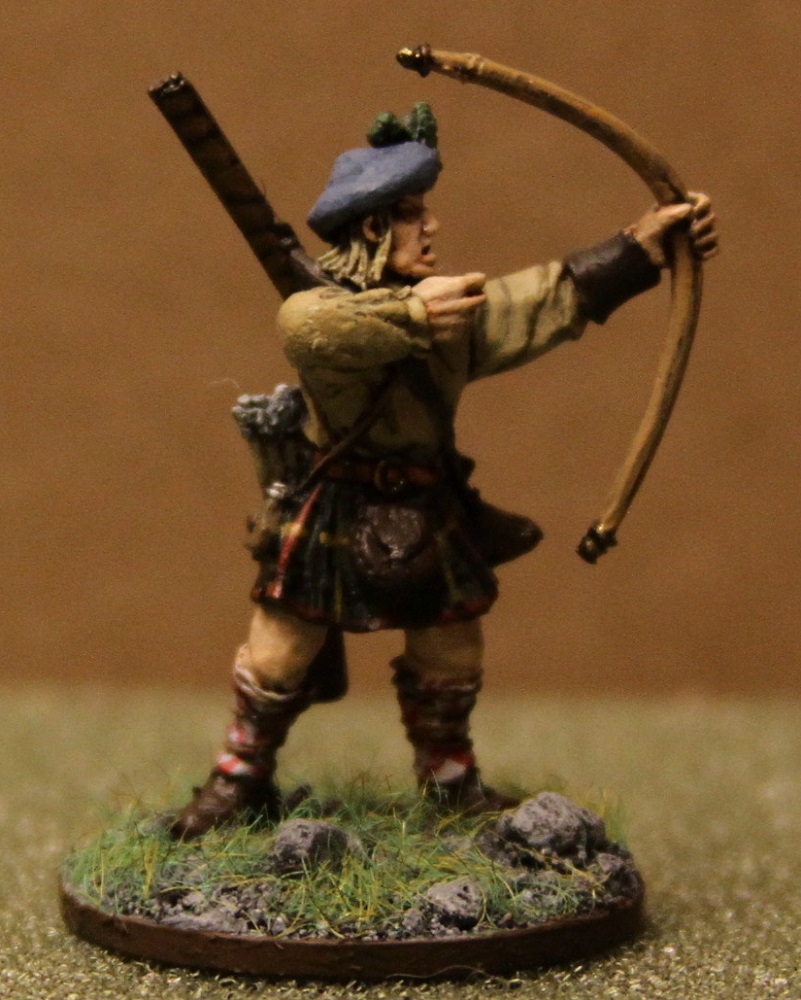
I had fun on the plaids, painting some from the 'clan' tartans now used (the red-bearded claymore carrier wears ancient Donald), and others up out of my head, like the trews (trousers) on right. These were easily the hardest, but most rewarding part of the models!


 The title comes from a c. 16th century Scottish ballad of the same name, referring to the blue caps usually worn by the Scots, and on all of these miniatures.


Check out my Etsy shop for more information on how I paint these, and thanks for looking!